
Stargazing with a Laser Pointer: What to Show in UK Skies, Season by Season
A green laser pointer makes it easy to show friends and family the stars. How to use one well, what to expect from a class 2 laser, and a season-by-season list of stars, constellations and planets to point out from the UK.
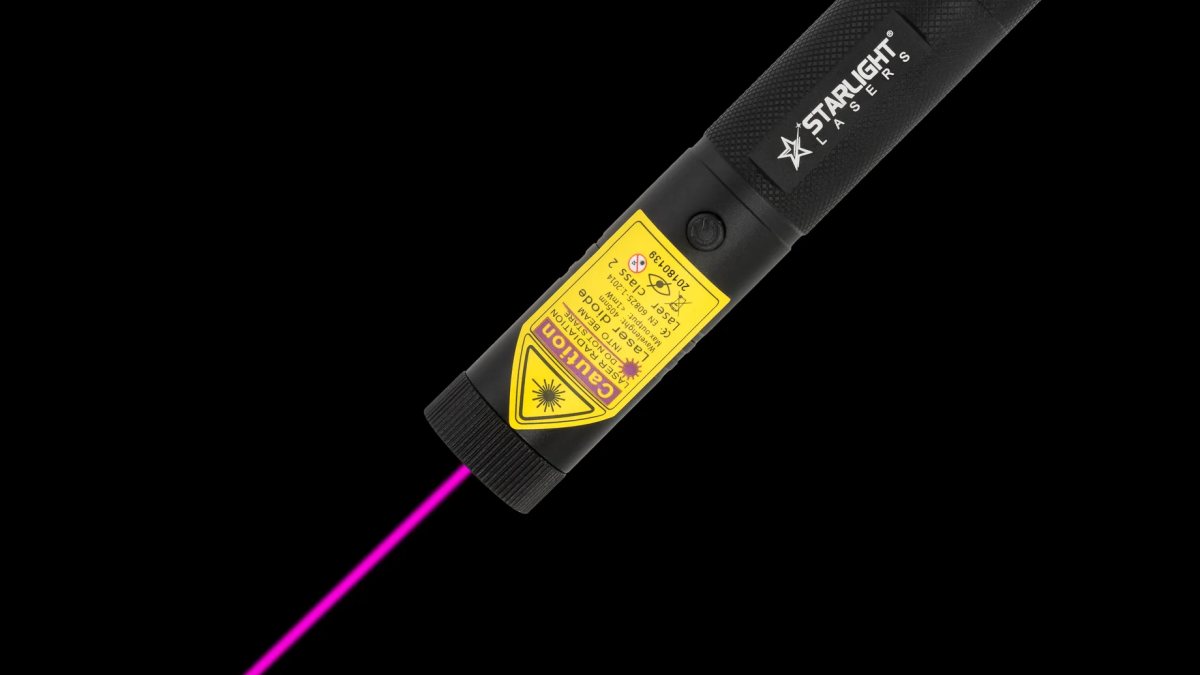
Anyone who has tried to show someone a star knows the problem. “See the bright one? No, left of that. Below the other bright one.” A green laser pointer cuts straight through it. Point, and the other person follows the line to exactly the star you mean. This guide explains how to use a laser for stargazing in the UK, what a class 2 laser can realistically do, and what to show at each time of year.
Why a green laser?
Our eyes are most sensitive to green light, around 532 nm, which is why astronomy pointers are green. On a dark, clear and slightly humid night, dust and moisture in the air scatter a little of the light sideways and the beam becomes faintly visible. People standing right beside you, looking along the beam, can follow that line up to the sky.
A word of honesty. The lasers sold to the public in the UK are class 2, up to 1 mW. With that output the beam is faint – it is not the bright rod you may have seen in photos of powerful lasers. You will see it well at a properly dark site with eyes adapted to the dark. In a town with street lights all around, you will struggle. Plan accordingly: get out of town, and keep your group close.
How to do it well
- Go somewhere dark. Even a few miles out of town makes a big difference. Dark-sky parks and open countryside are ideal.
- Adapt your eyes. Allow 15–20 minutes without looking at phones or torches. Use a red torch if you need light.
- Check for aircraft. Scan the whole sky before every use. If a plane, helicopter or drone is anywhere near, wait.
- Stand together. Have people stand behind your shoulder so they look along the beam.
- Short bursts. Switch on, point, name it, switch off. Long sweeps spoil everyone’s night vision and drain the battery.
- Start high. Switch on with the laser already pointing upwards, so the beam never crosses fields, roads or houses.
What to show: a season-by-season list for UK skies
All year: the circumpolar stars
From the UK some constellations never set. The Plough (part of Ursa Major) is the best starting point: follow the two stars at the end of its “pan” and you reach Polaris, the North Star. On the other side of Polaris is Cassiopeia, a clear “W” or “M”. Teaching someone this trio means they can find north on any clear night.
Winter (December to February)
The best season for a laser tour. Orion dominates the southern sky: three belt stars in a row, orange Betelgeuse at one shoulder and blue-white Rigel at the opposite foot. Follow the belt down and left to Sirius, the brightest star in the night sky; follow it up and right to orange Aldebaran and on to the Pleiades, the small, misty cluster also called the Seven Sisters.
Spring (March to May)
The Plough is high overhead. Follow the curve of its handle away from the pan – “arc to Arcturus” – to a bright orange star low in the east. Leo is in the south, with its “backwards question mark” of stars forming the lion’s head and bright Regulus at the bottom.
Summer (June to August)
Nights are short and never fully dark in much of the UK, so the beam is harder to see; wait until late in the evening and stick to the brightest stars. Look for the Summer Triangle: Vega, Deneb and Altair, three bright stars high in the south and east. On a dark August night, point out where the Milky Way runs through it.
Autumn (September to November)
The Square of Pegasus rides high in the south: four stars forming a large, nearly empty square. From its corner, a chain of stars leads to Andromeda, and near it, on a dark night, the faint smudge of the Andromeda Galaxy. By late autumn evening Orion is rising again in the east.
Planets
Bright planets move against the stars, so check an up-to-date sky app or almanac for what is visible. Venus is often a brilliant “evening star” in the west after sunset or a “morning star” before dawn; Jupiter is bright and steady. Pointing them out before the stars appear is a nice way to start an evening.
A laser and a pair of binoculars
A laser pointer and a simple pair of binoculars are a great combination. Point the laser at an object, let the other person line up the binoculars along the beam, and switch off before they look. It is the quickest way to get someone onto the Pleiades or the Andromeda Galaxy without a telescope.
Which laser for stargazing?
- G3 Pro – rechargeable, two safety keys, our most popular green laser. Ideal for regular stargazing and club evenings.
- G1 Pro – the same with a removable pattern lens for fun afterwards.
- G2 Pro – compact, for walks and travel.
- X1 – a slim green pen on AAA batteries, a good first laser for the observing bag.
Cold nights drain batteries faster, so keep a spare 18650 or 16340 cell warm in an inside pocket. Our laser pointer for astronomy page sums up the choice.
Safety and courtesy
Never point a laser at an aircraft – it can dazzle a pilot and it is a criminal offence in the UK. Always scan the sky first. Never aim at people, animals, vehicles or reflective surfaces, and keep the laser in adult hands. At public observing events, ask the organiser first: some prefer lasers to be used only by the host. Our laser pointer safety page covers the rest.
More articles
Blog
How to Scare Birds with a Laser Pointer: A Practical Plan for Farms, Gardens and Boats
Pigeons on the roof, gulls on the boat, starlings in the hedge, geese on the winter wheat: a site-by-site plan…
How to Keep Pigeons off Your Roof with a Laser Pointer
Pigeons on the ridge, in the gutter and on the solar panels? How to use a green laser pointer to break their e…
Keeping Seagulls off Your Boat, Mooring or Terrace with a Laser Pointer
Gulls on the deck, the wheelhouse roof or the café terrace? How boat owners and businesses use a green laser a…